
Beryllium (Be)
Beryllium: the lightest structural metal
Beryllium is a light, stiff, thermally stable metal used in aerospace structures, defence optics and precision instruments. It is produced by a very small number of operations worldwide, and it is one of the elements that marks a chemically evolved pegmatite system.
Beryllium is about a third lighter than aluminium and substantially stiffer than steel. That combination is why it ends up in satellite optics, inertial guidance and precision instruments, where a component has to hold its shape and cannot afford the weight.
Most beryllium is never used as pure metal. The largest application by volume is copper-beryllium alloy, where a small percentage transforms the copper into a high-strength, non-sparking, non-magnetic material used in connectors, tooling and oilfield hardware.
Investor updates
Following beryllium at White Willow?
News releases go out by email as the work advances. One address, no other details, and you can unsubscribe from any message.
Prefer to talk? +1 (778) 899-1780 or deepak@totecresources.com
Based on sales revenues, approximately 29% of beryllium products were used in consumer electronics, 24% in aerospace and defense applications, 17% in industrial components, 9% in automotive electronics, 8% in energy applications, 2% in semiconductor applications, and 11% in other applications.[1]

Supply
A handful of operations, worldwide
Beryllium has one of the most concentrated supply chains of any industrial metal. Global mine production is measured in a few hundred tonnes per year, and the great majority of it comes from a single operation.
Of the 58 mineral commodities included in the Final 2025 List of Critical Minerals (excluding metallurgical coal and uranium), the United States was 100% net import reliant for 13 mineral commodities, and an additional 20 critical mineral commodities (including 14 lanthanides, which are listed under rare earths) had a net import reliance greater than 50% of apparent consumption.[2]
Concentrated production
The United States Geological Survey reports that world beryllium mine production comes from a very small number of countries, with the United States accounting for the majority, followed by China and a limited contribution from other producers. Most United States output comes from bertrandite ore at Spor Mountain in Utah, processed through a single domestic refining and alloy facility.[1]
A narrow processing base
Refining beryllium ore into metal, alloy and oxide requires specialised hydrometallurgical and powder metallurgy capability, and only a handful of facilities worldwide operate it. Because production is small, closely held and technically demanding, published price and volume data are thinner than for most metals, and buyers of beryllium products are exposed to disruption at very few points.[1]
Why Western supply matters
That combination has pushed Western governments and manufacturers to look for additional sources, including beryl-bearing pegmatites in stable jurisdictions. Beryl in hard-rock pegmatite is not currently a major commercial source of beryllium in North America, and it should not be presented as one. Its practical significance for explorers is twofold: it is a potential future feedstock, and it is a reliable geological indicator. In the lithium-cesium-tantalum (LCT) pegmatite family, beryllium enrichment marks the point where a pegmatite system begins to fractionate away from its parent granite, and its presence helps map the path toward the more evolved tantalum, cesium and lithium bearing zones.
(1) U.S. Geological Survey, Mineral Commodity Summaries, Beryllium.[1] Supply and market information on this page is drawn from third-party sources and is provided for industry context only.
A small market the defence base cannot do without
United States beryllium consumption was 230 tons in 2025, worth about $360 million.[1] Close to a quarter of it went into aerospace and defence applications.[1]
Two hundred and thirty tons sounds like nothing. Try building a satellite without it.
A scattered, and largely non-allied, import base
Beryllium, share of United States imports, 2021 to 2024
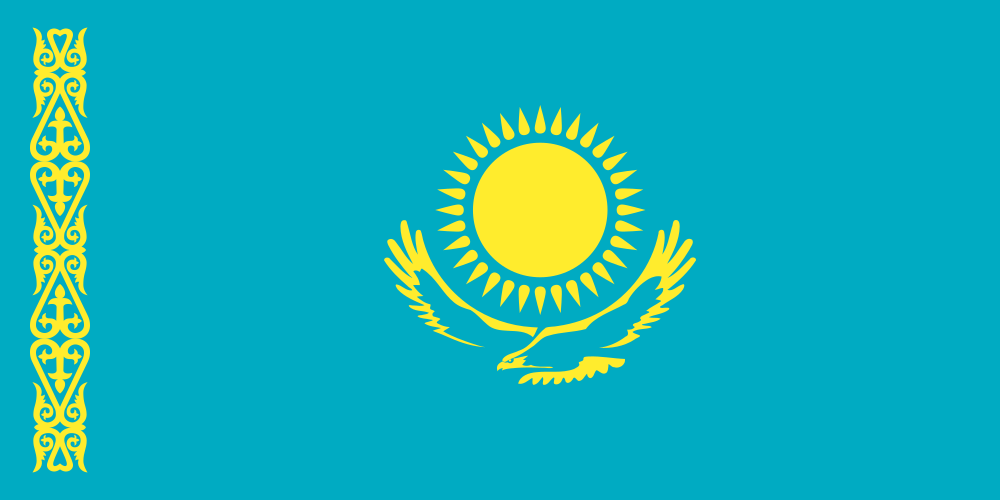

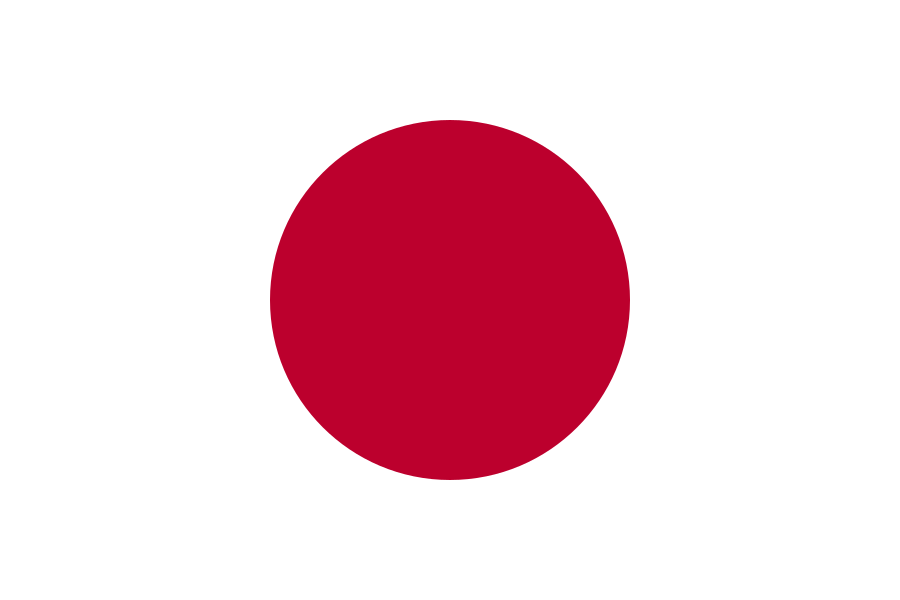

Source[1]
Canada was a major supplier of 16 of these mineral commodities, including 4 for which Canada was the leading supplier.[2]
At White Willow
What the filed work shows at White Willow
The White Willow Property in northwestern Ontario hosts beryl-bearing granitic pegmatites. Beryllium occurs there primarily as beryl, and it forms part of the indicator mineral assemblage that places the system at the evolved end of the LCT pegmatite sequence.
The highest beryllium figure on the property, 5,000 ppm from a selective grab sample at the Maple Leaf Dyke, was reported by Grid Metals Corp, a prior operator, in 2022. It is historical and not verified by Totec.
Beryl is one of the indicator minerals geologists expect from a highly fractionated LCT pegmatite, and it is the reason the beryllium occurrence at White Willow is treated as a vectoring tool as much as a commodity in its own right.
See the geology at White Willow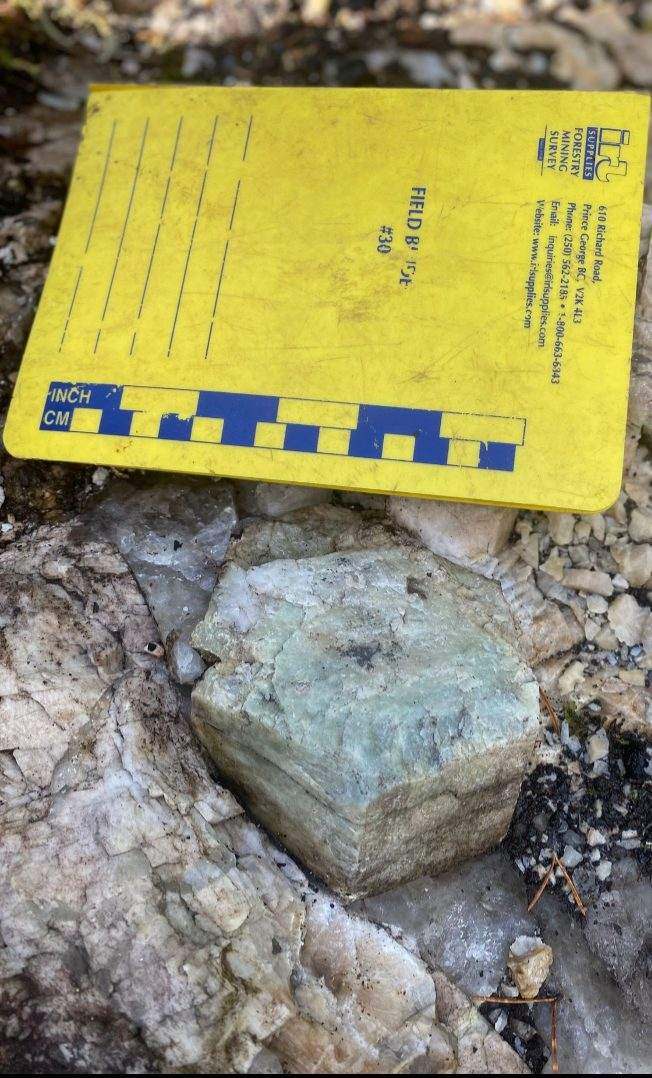
Reported beryllium figures
| Item | Reported value | Sample type | Attribution |
|---|---|---|---|
| Beryllium, Maple Leaf Dyke | 5,000 ppm Be | Selective grab sample | Grid Metals Corp, 2022 prospecting (prior operator) |
| Host mineral | Beryl (beryllium aluminium silicate) | Field observation | Technical report on the White Willow Property |
| Host rock | Beryl-bearing granitic pegmatites | Mapping and prospecting | Technical report on the White Willow Property |
White Willow is an LCT pegmatite property in Ontario carrying lithium, cesium and tantalum, with beryl present at the Maple Leaf showing. Beryllium is treated as an indicator of a fractionated, fertile system rather than as a stand-alone target.
See it in the rock
Review the project geology, or read how the critical metals at White Willow connect to North American supply.
Investor updates
Get the next update on this ground
If the beryllium story is worth watching, the fastest way to follow it is by email. You can also speak to the CEO directly.
Prefer to talk? +1 (778) 899-1780 or deepak@totecresources.com
Common Questions
Frequently asked
What is beryllium used for?
Beryllium is exceptionally light and stiff, with the highest specific stiffness of any structural metal, and it is transparent to X-rays. That combination puts it in aerospace structures, satellite optics, inertial guidance systems, X-ray windows and nuclear applications. Copper-beryllium alloys, which are non-sparking and non-magnetic, are used in tooling for hazardous environments and in high-reliability electrical contacts.
Where does beryllium come from?
Mine supply is unusually concentrated in a very small number of operations, with the United States historically supplying the majority of world production from bertrandite ore. Beryl, the mineral more familiar as emerald and aquamarine, is the other principal source and is the form in which beryllium occurs in granitic pegmatites.
What is beryl?
Beryl is a beryllium aluminium silicate. Its gem varieties are emerald and aquamarine, but as an industrial mineral it is the beryllium-bearing phase found in granitic pegmatites. Its appearance in a pegmatite marks the first of the rare-element zones in the LCT fractionation sequence.
Sources
References
Every numbered claim on this page is attributed to the source it came from.
- pubs.usgs.gov Mineral Commodity Summaries 2026, Beryllium, U.S. Geological Survey
- pubs.usgs.gov Mineral Commodity Summaries 2026, U.S. Geological Survey, March 2026
- sedarplus.ca NI 43-101 Technical Report on the White Willow Property, Thunder Bay South Mining District, Ontario, filed on SEDAR+
- geologyontario.mndm.gov.on.ca 2022 Surface Prospecting Report, White Willow Property, Grid Metals Corp, assessment file AFRI 20000022099
Sources are named to identify where the information came from. Their inclusion does not indicate any affiliation with, sponsorship of, or endorsement of Totec Resources Ltd. by the organisations cited, or by the Government of the United States. Third-party statements describe the metal and its supply chain. They are not statements about Totec Resources Ltd. or the White Willow Property, and no inference should be drawn from them as to the presence, grade or economic viability of any mineralization on the Property.
Totec Resources has no mineral resource estimate on the White Willow Property. No mineral resource or mineral reserve has been defined, and no figure on this page should be interpreted as a resource, a reserve or an indication of economic potential.
Grab samples referenced on this page are selective by nature and are not representative of the mineralization hosted on the property. Beryllium values from the Maple Leaf Dyke were reported by Grid Metals Corp, a prior operator, from its 2022 prospecting. Totec Resources has not independently verified these historical third-party results, and they should not be relied upon.
The scientific and technical information on this page has been reviewed and approved by Deepak Varshney, P.Geo, CEO and Director of Totec Resources, a Qualified Person as defined by National Instrument 43-101.
Market, supply and application information regarding beryllium is drawn from third-party sources, including the U.S. Geological Survey, and is provided for general industry context only.[1] It is not a forecast of prices, not a statement that Totec's minerals are used in any product or system described, and not investment advice.
This page contains forward-looking statements regarding Totec Resources Ltd. and its exploration plans. Actual results may differ materially, and readers should not place undue reliance on forward-looking information.