The Demand Case
Critical metals for a North American supply chain
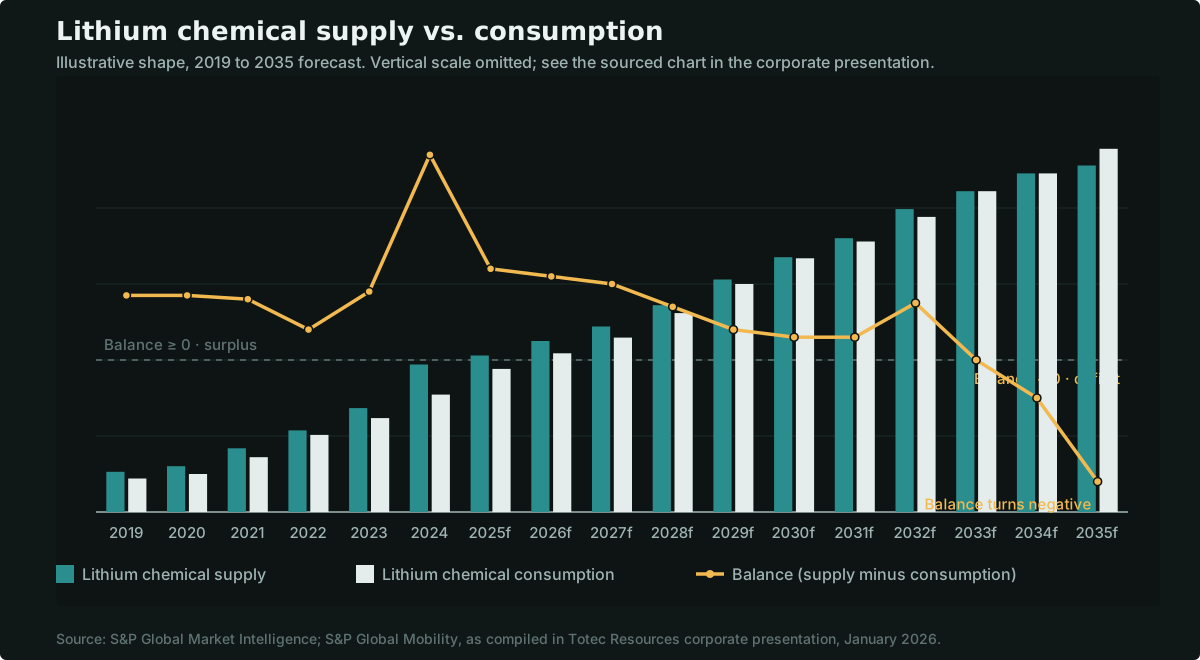
Electrification, defence and advanced manufacturing all depend on a small group of critical metals, and Western governments are moving to onshore their supply. White Willow carries three of them in a single deposit.
Why These Metals
Named critical on both sides of the border
Lithium, cesium and tantalum are not ordinary commodities. Governments across North America classify them as critical: metals essential to the economy and defence, yet exposed to concentrated foreign supply and potential disruption.
Canada
Canada lists lithium, cesium and tantalum on its Critical Minerals List, and prioritises building secure, domestic supply chains for the metals that underpin the energy transition and national security.[1]
United States
All six of the metals covered on this page appear on the Final 2025 List of Critical Minerals, the 60-mineral list published by the Secretary of the Interior through the U.S. Geological Survey in November 2025.[2] The same list records rubidium as produced as a byproduct or co-product, naming cesium and lithium as its host commodities, which is the pegmatite co-product model set out in federal terms.[2]
Named critical is also named strategic
The same three metals sit inside the defense supply chain the West is racing to secure. Cesium atomic clocks are the timing backbone of GPS and secure military communications; tantalum forms the capacitors inside defense electronics and strengthens the superalloys used in jet engines; and lithium powers military energy storage. Washington has moved to build allied, non-Chinese supply of critical minerals, from Defense Production Act awards to the National Defense Stockpile.
Defense demand information is drawn from third-party sources, including the U.S. Geological Survey, the U.S. Department of Defense and the Defense Logistics Agency, and is provided for market and industry context only.[3] It is not a prediction of Totec's results, and it is not a statement that Totec's minerals are used in any defense system.
White Willow's LCT pegmatite system carries all three of these critical minerals, lithium, cesium and tantalum, within a single project in Ontario, a stable North American jurisdiction.
Policy Backdrop
Washington is putting money behind the supply chain
On 7 August 2026 the White House announced over $2 billion in critical mining and mining-related projects, alongside a further $180 million for the American mining workforce. Two of the six metals covered on this page were named directly.[4]
The Export-Import Bank is investing $25 million into Global Advanced Materials in Pennsylvania for tantalum and niobium to support electronic, magnet, and steel production.[4]

The scale of the programme
The August announcement was not an isolated one. The White House states that since January 2025 the administration has signed or approved 160 minerals deals worth almost $40 billion, and that it has used Section 232 to cover critical minerals among other goods.[4]
Why governments are moving
The stated rationale is supply concentration rather than geology. Excluding rare earths, the average share of the top refining country rose to 72% in 2025, up from 70% in 2023, and China was the leading supplier of eight of the mineral commodities for which the United States is import reliant.[5][3]
Critical materials build and power the modern world from cars to military weaponry and factory machinery to smartphones and computers. It is vital that the United States have sufficient and secure mining, processing, refining, manufacturing, and recycling to reduce reliance on foreign countries.[4]
The investments described above are investments by agencies of the United States government in other companies, named in the source document. The Export-Import Bank names the recipient "Global Advanced Metals"; the quotation above reproduces the White House wording exactly. Totec Resources Ltd. is not a party to, a beneficiary of, or an applicant for any of the programmes referred to on this page, and none of the companies named is related to Totec. This information is provided for market and industry context only. It is not a prediction of Totec's results and does not imply that Totec's minerals are or will be used in any government programme or defence system.[4]
White Willow is spodumene-bearing with samples up to 0.5% Li2O, the hard-rock lithium mineral that feeds the battery supply chain.[6]
Surface sampling has returned 36 samples above 115 ppm Cs at Maple Leaf, marking a highly evolved pegmatite system with a genuine cesium signature.[6]
White Willow has returned coarse tantalite assaying 14.64% Ta2O5 from a selective surface grab sample at Maple Leaf.[6]
The LCT Advantage
One deposit family, three critical metals
Lithium, cesium and tantalum are not separate exploration bets at White Willow. They belong to a single deposit type, the LCT (lithium-cesium-tantalum) pegmatite, in which the three metals occur together as a natural mineral family.
LCT pegmatites become progressively more chemically evolved with distance from their parent granite. That fractionation leaves a predictable trail: beryllium, then niobium-tantalum, then cesium enrichment mark the most evolved zones. Where those indicators appear, they point toward the lithium mineralization that sits at the fertile end of the sequence.
In practical terms, the tantalum and cesium signals at White Willow are more than standalone results. They are vectors: evidence that the system is highly fractionated and therefore prospective for lithium.
See the geology at White Willow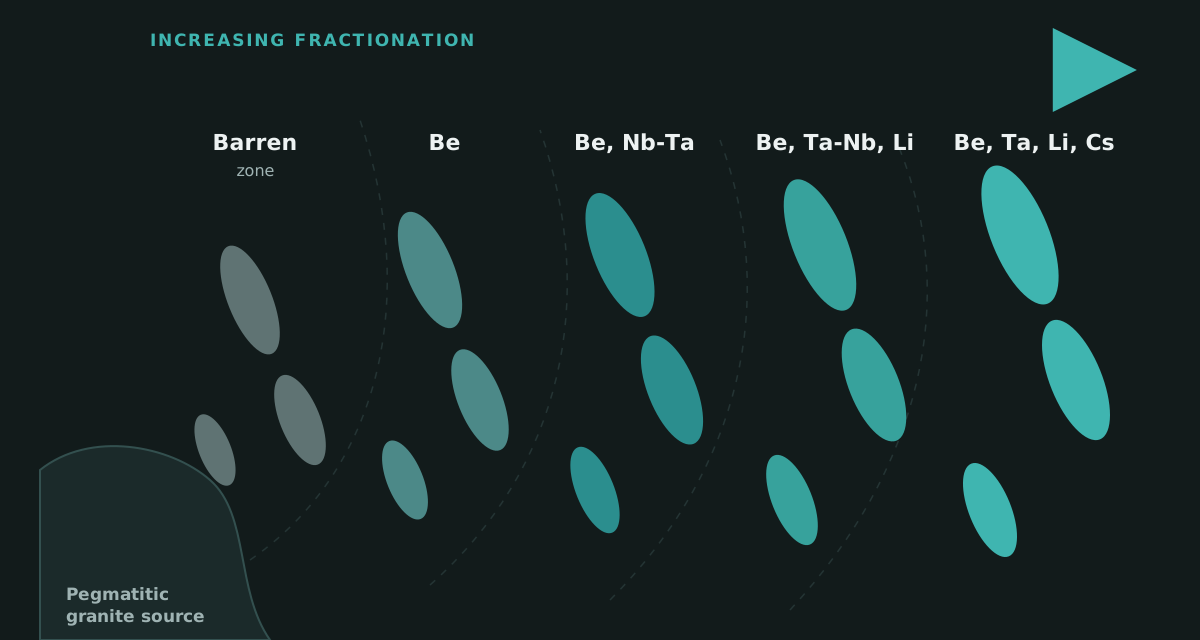
Supply Concentration
Where these six metals actually come from
The case for new Western supply is not a matter of opinion. The United States Geological Survey publishes an annual net import reliance figure for every commodity, alongside the countries those imports come from. The table below reproduces the 2026 figures for the six metals present in the White Willow system.
Of the 58 mineral commodities included in the Final 2025 List of Critical Minerals (excluding metallurgical coal and uranium), the United States was 100% net import reliant for 13 mineral commodities, and an additional 20 critical mineral commodities (including 14 lanthanides, which are listed under rare earths) had a net import reliance greater than 50% of apparent consumption.[3]

| Metal | U.S. net import reliance | Principal sources | Canada list | U.S. list |
|---|---|---|---|---|
| Cs Cesium | 100% | No domestic mine production in 2025. Producers estimated to include Canada, China, Germany and Russia | Yes | Yes |
| Ta Tantalum | 100% | Ores and concentrates: Australia 64%, Mozambique 10%, Congo (Kinshasa) 9%. Metal and powder: China 47%, Germany 25%, Kazakhstan 16% | Yes | Yes |
| Nb Niobium | 100% | Brazil 67%, Canada 28%, other 5% | Yes | Yes |
| Rb Rubidium | 100% | No primary mine production anywhere in the world. Recovered only as a by-product of lithium and cesium processing | Not listed | Yes |
| Li Lithium | Greater than 50% | Chile 54%, Argentina 43%, other 3%. Refining capacity is separately concentrated in China | Yes | Yes |
| Be Beryllium | Domestic production | The United States is a significant producer and is not among the commodities for which it is wholly import reliant. Supply is nonetheless concentrated in a very small number of operations | Not listed | Yes |
 Net import reliance and import source figures: U.S. Geological Survey, Mineral Commodity Summaries 2026. Import source shares cover 2021 to 2024. Critical minerals list status: Natural Resources Canada and the 2025 United States critical minerals list. Beryllium and rubidium do not appear on Canada's list. This table describes global supply for these commodities and is not a statement about the White Willow Property or about any mineralization on it.
China was the leading supplier of eight of these mineral commodities and was a major supplier of six others.[3]
Canada was a major supplier of 16 of these mineral commodities, including 4 for which Canada was the leading supplier.[3]
It is the policy of the United States that not only the finished equipment deployed by our military, but also the critical materials and components necessary to manufacture, maintain, sustain, and repair that equipment, are sourced domestically or from allied nations.[9]
See how the metals show up in the rock
Explore the flagship project, or review the capital structure and corporate materials.
Market and macro information on this page describes general supply and demand for critical minerals and is drawn from third-party sources. It is provided for context only and is not a forecast of prices or of Totec Resources' results.
The scientific and technical information on this page has been reviewed and approved by Deepak Varshney, P.Geo, CEO and Director of Totec Resources, a Qualified Person as defined by National Instrument 43-101.
Historical exploration results referenced from the 2022 Surface Prospecting Report filed for assessment (AFRI 20000022099). Totec has not independently verified these historical results, and they should not be relied upon.
This page contains forward-looking statements regarding Totec Resources Ltd. and its exploration plans. Actual results may differ materially, and readers should not place undue reliance on forward-looking information.
Sources
References
Every numbered claim on this page is attributed to the source it came from.
- canada.ca The Canadian Critical Minerals Strategy, Natural Resources Canada
- federalregister.gov Final 2025 List of Critical Minerals, U.S. Geological Survey, 90 FR 50494, November 7, 2025
- pubs.usgs.gov Mineral Commodity Summaries 2026, U.S. Geological Survey, March 2026
- whitehouse.gov Fact Sheet: President Donald J. Trump Announces Billions in New Deals and Investments to Power American Mining, The White House, August 7, 2026
- iea.org Global Critical Minerals Outlook 2026, Executive Summary, International Energy Agency
- geologyontario.mndm.gov.on.ca 2022 Surface Prospecting Report, White Willow Property, Grid Metals Corp, assessment file AFRI 20000022099
- pubs.usgs.gov Mineral Commodity Summaries 2026, Cesium, U.S. Geological Survey
- pubs.usgs.gov Mineral Commodity Summaries 2026, Tantalum, U.S. Geological Survey
- whitehouse.gov Executive Order 14415, Securing America's Defense Supply Chains and Ensuring Domestic Acquisition of Critical Materials, July 20, 2026
- totecresources.com Totec Resources Ltd., Corporate Presentation, August 2026
Sources are named to identify where the information came from. Their inclusion does not indicate any affiliation with, sponsorship of, or endorsement of Totec Resources Ltd. by the organisations cited, or by the Government of the United States. Third-party statements describe the metal and its supply chain. They are not statements about Totec Resources Ltd. or the White Willow Property, and no inference should be drawn from them as to the presence, grade or economic viability of any mineralization on the Property.