Element Guide: Lithium (Li)
Lithium: the metal that stores the energy transition
In 1996 the United States was the world's dominant lithium producer. Today it imports more than half of what it consumes, and one country refines most of what everyone else digs up. The metal itself is the lightest on the periodic table and the active ingredient in every EV battery and grid storage bank.[1]
Investor updates
Following lithium at White Willow?
News releases go out by email as the work advances. One address, no other details, and you can unsubscribe from any message.
Prefer to talk? +1 (778) 899-1780 or deepak@totecresources.com
Lithium consumption for batteries increased significantly owing to the use of rechargeable lithium batteries in the growing market for electric vehicles (EVs), energy grid storage applications, portable electronic devices, and electric tools.[3]

Supply
Mined in one place. Refined in another.
Lithium reaches the market by two main routes: continental brines and hard-rock pegmatites. Both are geographically concentrated, and both sit some distance from the refining and cell-manufacturing capacity that Western economies are trying to build.
Today, the United States relies on imports for more than one-half of the lithium and more than two-thirds of the rare-earth compounds and metals it consumes.[2]
Brine
Lithium-bearing groundwater is pumped from beneath salt flats, most notably in the high plateau of Chile and Argentina, then concentrated in evaporation ponds before chemical processing. Brine operations have historically carried low operating costs, but they are slow to build and take many months to move material through the evaporation circuit.
Hard rock
Lithium is mined from granitic pegmatites, principally as the mineral spodumene, then concentrated and shipped to converters. Australia is the dominant hard-rock producer, with growing output from Africa and from Canadian projects in Quebec, Ontario and Manitoba. Hard-rock operations respond faster to demand and lend themselves to conventional mining and flotation.
Concentration and the case for Western supply
Mine supply is concentrated in a small number of countries, and the downstream chemical conversion step is more concentrated still, with China refining the majority of the world's lithium chemicals regardless of where the rock or brine originated. A cell plant in North America or Europe therefore depends on a supply chain that leaves the continent and returns, which is precisely the exposure governments have moved to reduce.
Industry context only. Not a forecast of prices or of Totec's results.
The price reset. The demand did not.
Lithium carbonate sold for $9,000 a ton in 2025, down 31 percent in a year.[3] That is what the bottom of a cycle looks like. Consumption for batteries kept climbing straight through it, pulled by electric vehicles, grid storage and portable electronics.[3]
Cycles turn. The processing bottleneck does not turn with them.
Two countries supply almost all of it
Lithium, share of United States imports, 2021 to 2024

Source[3]
Excluding rare earths, the average share of the top refining country rose to 72% in 2025, up from 70% in 2023.[5]
The Property
What the filed work shows at White Willow
White Willow is a lithium-cesium-tantalum (LCT) pegmatite property near Atikokan, Ontario. The source of record for the figures below is the filed National Instrument 43-101 technical report on the property.
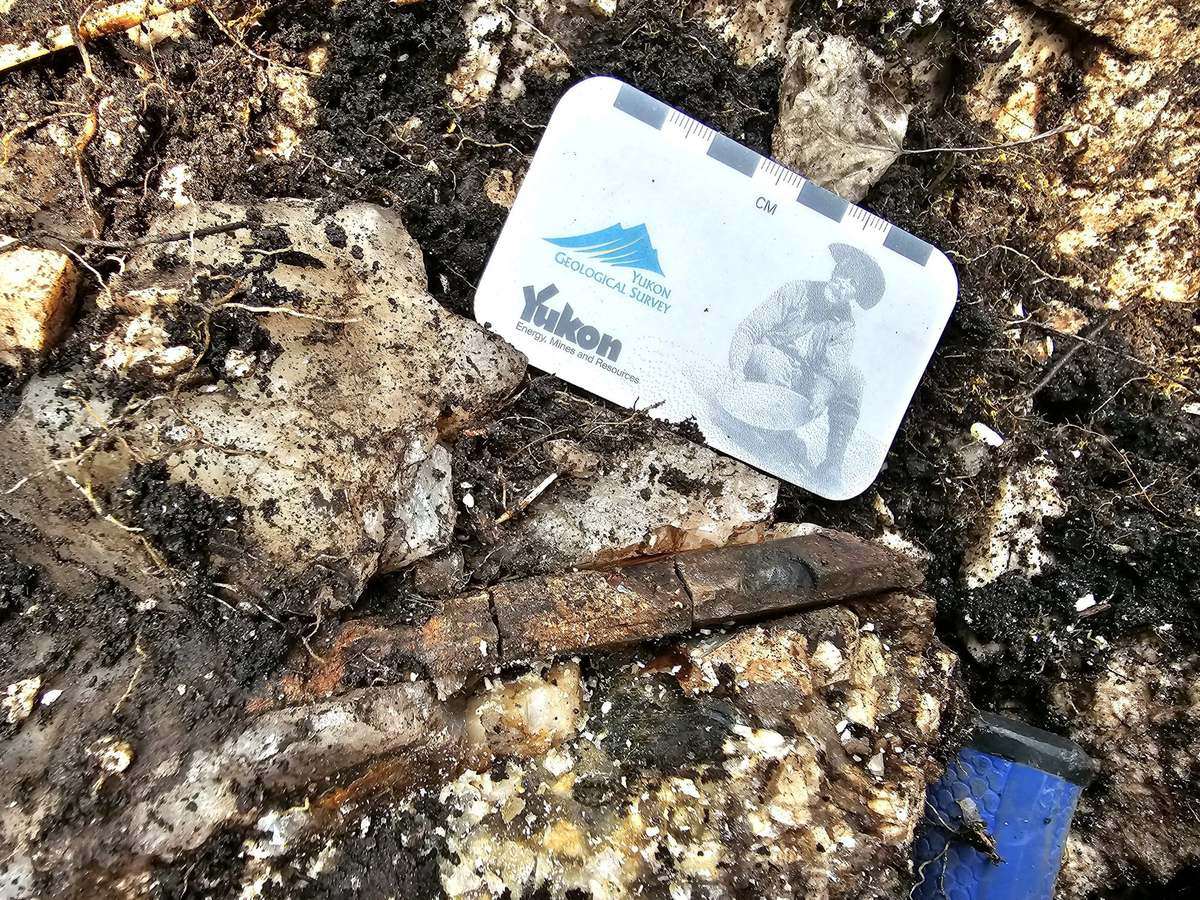
The lithium case at White Willow rests on three lines of evidence. First, the pegmatites are spodumene bearing, which is the mineral form that feeds the hard-rock supply chain. Second, muscovite chemistry across the sampled pegmatites sits above the accepted fertility threshold, indicating a system evolved enough to carry lithium. Third, the swarm is large and was still growing with each mapping campaign, which speaks to the amount of untested ground rather than to any defined quantity of metal.
The 2022 prospecting at the Maple Leaf Dyke was carried out by Grid Metals Corp., a prior operator; those results are historical and not verified by Totec. The muscovite and exocontact ranges are drawn from the technical report's own sampling discussion. Grab samples are selective by nature.
| Measure | Result | Attribution |
|---|---|---|
| Maximum lithium assay | 0.5% Li2O | Selective grab sampling, 2022 prospecting at the Maple Leaf Dyke by Grid Metals Corp., a prior operator |
| Samples above 1,000 ppm Li | Six samples | Selective grab sampling, same 2022 Grid Metals Corp. programme |
| Muscovite lithium content | 237 to 1,550 ppm Li | Technical report sampling discussion. All samples above 200 ppm, the fertile granite minimum |
| Largest exocontact metasediment assay | 1,310 ppm Li | Technical report sampling discussion |
| Lithium mineralogy | Spodumene bearing pegmatites | Technical report |
| Anomalous lithium samples, 2023 programme | 45 samples above 300 ppm Li, of 103 above 115 ppm | Technical report. Six of these assayed above 1,000 ppm Li |
| Pegmatite swarm extent after the 2023 programme | 3 km strike length by 900 m width | Technical report. Reported alongside 45 newly discovered pegmatites in that programme. The Maple Leaf trend as a whole is described elsewhere as roughly 8 km by 1 km with about 3 km mapped in detail |
How to read these numbers
The 0.5% Li2O maximum and the six samples above 1,000 ppm Li are single-point selective results, and they establish that lithium is present in tenor, not how much of it exists. Converting evidence of this kind into any statement of quantity requires systematic drilling, assaying and independent estimation work that has not been completed. That work is the purpose of the exploration programme, and its outcome is unknown.
The full property picture, including the Maple Leaf showing, the pegmatite swarm geometry and the planned work programme, is set out on the project page. The wider argument for lithium, cesium and tantalum as a single deposit family and as a North American supply-chain priority is set out on the critical metals page.
Investor updates
Get the next update on this ground
If the lithium story is worth watching, the fastest way to follow it is by email. You can also speak to the CEO directly.
Prefer to talk? +1 (778) 899-1780 or deepak@totecresources.com
Common Questions
Frequently asked
What is lithium used for?
Lithium's dominant use is the cathode and electrolyte chemistry of rechargeable batteries, which power electric vehicles, consumer electronics and grid-scale energy storage. Beyond batteries it is used in ceramics and glass, high-temperature lubricating greases, continuous casting flux, air treatment and certain pharmaceuticals.
Where does the world's lithium come from?
Production splits between hard-rock spodumene pegmatites, principally in Australia, and brine operations in the South American salar triangle of Chile, Argentina and Bolivia. Refining is a separate bottleneck from mining, and refining capacity is heavily concentrated in China regardless of where the raw material is mined.
What is an LCT pegmatite?
LCT stands for lithium, cesium and tantalum. It describes a family of granitic pegmatites enriched in those rare elements, formed from the last and most chemically evolved fraction of a granitic melt. LCT pegmatites are the main hard-rock source of lithium, and effectively the only source of cesium.
What is spodumene?
Spodumene is a lithium aluminium silicate and the principal lithium ore mineral in hard-rock pegmatites. Its presence in a pegmatite indicates the system fractionated far enough to concentrate lithium into its own mineral phase rather than leaving it dispersed in micas.
Is lithium a critical mineral in Canada?
Yes. Lithium appears on Canada's Critical Minerals List, the federal register of minerals considered essential to economic security and to the transition to a low-carbon economy.
Sources
References
Every numbered claim on this page is attributed to the source it came from.
- sedarplus.ca NI 43-101 Technical Report on the White Willow Property, Thunder Bay South Mining District, Ontario, filed on SEDAR+
- pubs.usgs.gov Mineral Commodity Summaries 2026, U.S. Geological Survey, March 2026
- pubs.usgs.gov Mineral Commodity Summaries 2026, Lithium, U.S. Geological Survey
- canada.ca The Canadian Critical Minerals Strategy, Natural Resources Canada
- iea.org Global Critical Minerals Outlook 2026, Executive Summary, International Energy Agency
- totecresources.com Totec Resources Ltd., Corporate Presentation, August 2026
- geologyontario.mndm.gov.on.ca 2022 Surface Prospecting Report, White Willow Property, Grid Metals Corp, assessment file AFRI 20000022099
Sources are named to identify where the information came from. Their inclusion does not indicate any affiliation with, sponsorship of, or endorsement of Totec Resources Ltd. by the organisations cited, or by the Government of the United States. Third-party statements describe the metal and its supply chain. They are not statements about Totec Resources Ltd. or the White Willow Property, and no inference should be drawn from them as to the presence, grade or economic viability of any mineralization on the Property.
Totec Resources has no mineral resource estimate and no mineral reserve estimate on the White Willow Property. The exploration results described on this page are early-stage and do not establish the existence of a mineral resource or of economically recoverable mineralization. Grab samples are selective by nature and are not necessarily representative of the mineralization on the property.
Historical results attributed to Grid Metals Corp., a prior operator of the property, were not generated by Totec Resources. Totec has not independently verified those results and they should not be relied upon.
Market, supply and demand information on this page is general industry context drawn from third-party sources. It is not a forecast of commodity prices, is not a prediction of Totec's results, and is not investment advice.
The scientific and technical information on this page has been reviewed and approved by Deepak Varshney, P.Geo, CEO and Director of Totec Resources, a Qualified Person as defined by National Instrument 43-101.
This page contains forward-looking statements regarding Totec Resources Ltd. and its exploration plans. Actual results may differ materially from those expressed or implied, and readers should not place undue reliance on forward-looking information.