Tantalum (Ta)
Tantalum: the capacitor metal behind phones, jet engines and defence electronics
Element 73 is dense, corrosion resistant and almost impossible to substitute in the components that hold a charge inside modern electronics. It is also one of the most geographically concentrated metals in the periodic table, which is why Western governments list it as critical and why a North American source matters.
The second major use is metallurgical. Small additions of tantalum to nickel-based superalloys improve strength at high temperature, which is why the metal ends up in turbine sections of jet engines.
Electronics
Compact, thermally stable capacitors for phones, computers, automotive controllers, medical implants and defence and space electronics. The largest single end use.
Aerospace alloys
An additive in nickel-based superalloys used in turbine blades and other hot-section components, improving strength and oxidation resistance at high temperature.
Chemical and medical
Corrosion-resistant process equipment, tantalum carbide cutting tools, and biologically inert surgical implants and mesh.
Sources[1]
Industry context. Does not describe any Totec Resources product.
Investor updates
Following tantalum at White Willow?
News releases go out by email as the work advances. One address, no other details, and you can unsubscribe from any message.
Prefer to talk? +1 (778) 899-1780 or deepak@totecresources.com
Companies in the United States produced tantalum alloys, capacitors, carbides, compounds, and tantalum metal from imported tantalum ores and concentrates and tantalum-containing materials.[1]

Supply
Not mined in America since 1959
Tantalum has one of the most concentrated supply profiles of any listed critical mineral. The majority of world mine supply originates in central Africa, principally the Democratic Republic of the Congo and Rwanda, with additional output from Nigeria, Ethiopia and Brazil.
Tantalum has not been mined in the United States since 1959.[1]
Concentration risk
Much of that African production comes from artisanal and small-scale workings rather than industrial mines. Output responds to local security conditions and to informal trade routes as much as to price, so volumes and quality are difficult to forecast, and the material can be hard to trace back to a specific site.
Compliance exposure
Tantalum is one of the four conflict minerals, alongside tin, tungsten and gold, covered by U.S. conflict-minerals reporting rules and by comparable European Union due-diligence requirements. Buyers must document supply chains, which adds cost and legal exposure to material sourced from the affected region.
The rest of the market is thin. Australia holds hard-rock tantalum capacity in its lithium-bearing pegmatites, where tantalum can be recovered alongside spodumene, but that capacity has moved in and out of production with the lithium cycle rather than with tantalum demand. Brazil produces from pegmatite and alluvial sources, and some units reach the market from tin slag processing and from recycling of capacitor scrap.
North America has essentially no domestic mine production of tantalum. United States capacitor and superalloy manufacturers run entirely on imported ore and concentrate, which arrives from Australia, Africa and the Gulf.
A consequence follows for exploration. A tantalum occurrence in a stable jurisdiction with existing infrastructure and transparent permitting is strategically different from an equivalent occurrence in a concentrated supply region, because it can be traced and audited against those documentation requirements. Ontario, with its established mining law, road network and skilled contractor base, is one of the jurisdictions where that argument applies.
Third-party market context, not a forecast of prices or of Totec's results.
Consumption jumped 58 percent in one year
United States tantalum consumption reached 890 tons in 2025, a 58 percent increase in a single year.[1] By November, ore was fetching $180 per kilogram of contained Ta2O5.[1]
None of it was mined in America. Every ton arrived by ship.
Where United States tantalum ore actually comes from
Tantalum ores and concentrates, share of United States imports, 2021 to 2024
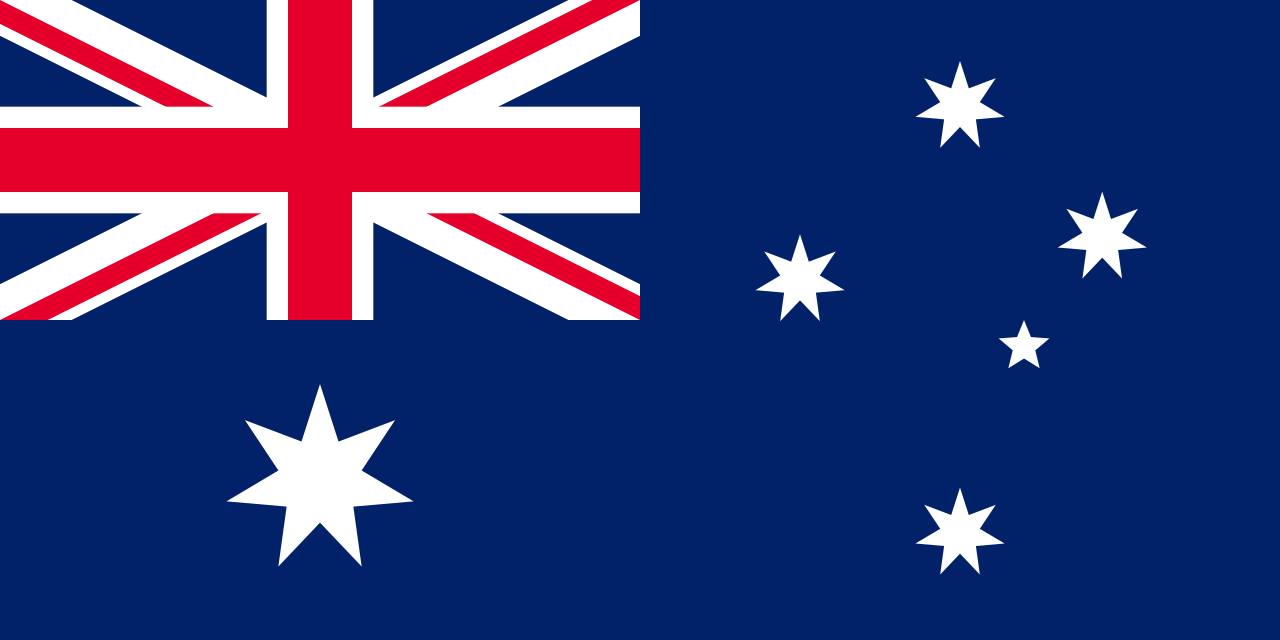
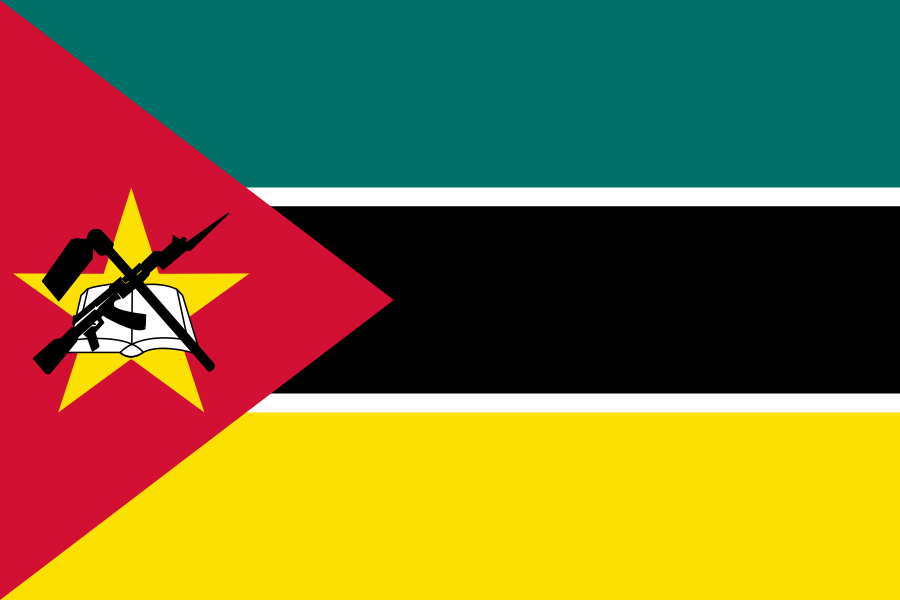
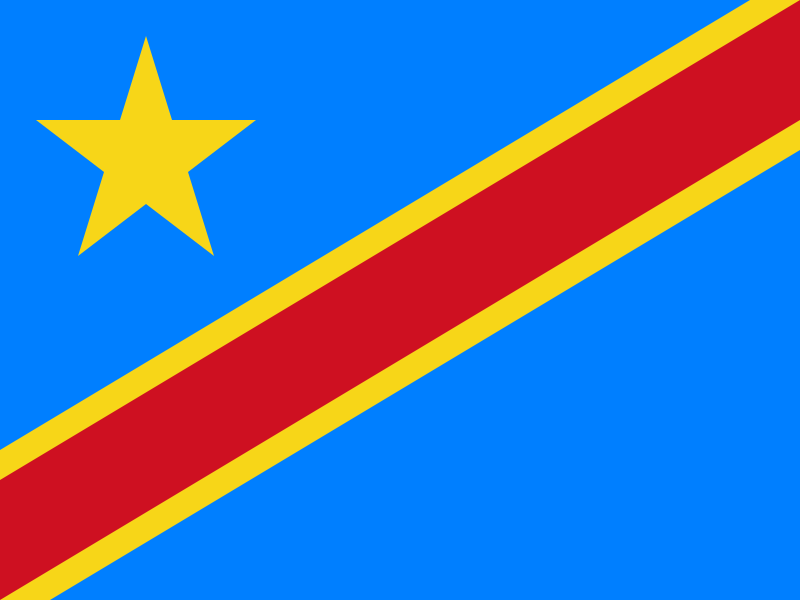

Source[1]
Tantalum ores and concentrates: Australia, 64%; Congo (Kinshasa), 9%; Mozambique, 10%; United Arab Emirates, 5%; and other, 12%.[1]
A deadline, not just a subsidy
Tantalum is one of only five materials designated a "covered material" in the defense acquisition rules, in a clause whose title names it explicitly: the Restriction on the Acquisition of Certain Magnets, Tantalum, and Tungsten.[3] That designation is what gives the following instruction its teeth.
On January 1, 2027, the Secretary of War (Secretary) and the Secretaries of the military departments shall cease to issue waivers under 10 U.S.C. 4872(c)(1) for the acquisition of covered materials under 10 U.S.C. 4872, except as provided in subsection (b) of this section.[4]

The order stops short of an outright ban. Waivers may still be issued where a contractor submits a formal mitigation plan that the Secretary accepts.[4] What changes on that date is the default: sourcing tantalum outside domestic and allied supply stops being routine and starts requiring a documented case.
And the money followed, three weeks later
On 7 August 2026 the White House announced over $2 billion in critical mining and mining-related projects. Tantalum was named directly, alongside niobium.[5]
The Export-Import Bank is investing $25 million into Global Advanced Materials in Pennsylvania for tantalum and niobium to support electronic, magnet, and steel production.[5]
The investment described above is an investment by an agency of the United States government in a third-party company named in the source document. The Export-Import Bank names the recipient "Global Advanced Metals"; the quotation above reproduces the White House wording exactly. Totec Resources Ltd. is not a party to it, is not a beneficiary of it, and is not an applicant to any related programme. The covered-material designation applies to tantalum as a material and is not a statement about any particular deposit or producer. This information is provided for market and industry context only and is not a prediction of Totec's results.[5][3]
The Property
What the filed work shows at White Willow
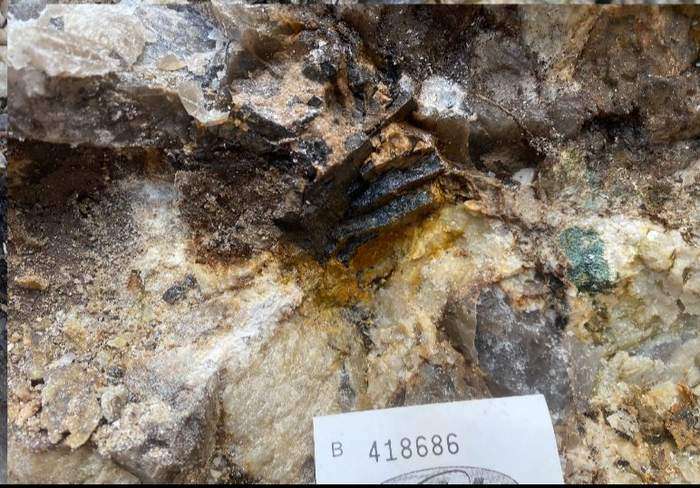
The White Willow Property near Atikokan, Ontario, is an LCT (lithium-cesium-tantalum) pegmatite project. Tantalum at White Willow is carried in columbite and tantalite, the same oxide minerals that host the metal worldwide, and it has been observed as coarse, visible crystals in outcrop at the Maple Leaf showing.
The figures below are from the filed technical report on the White Willow Property.[6] The strongest results come from Grid Metals Corp's 2022 prospecting at the Maple Leaf Dyke, historical and not verified by Totec. Grab samples are selective by nature.
| Result | Sample type | Location | Attribution |
|---|---|---|---|
| 14.64% Ta2O5, equivalent to about 12% Ta, in coarse tantalite | Selective grab sample, surface | Maple Leaf | 2022 prospecting programme (prior operator). Reported in the technical report both as 14.64% Ta2O5 and as 12% Ta, which are the same result expressed as oxide and as element |
| 3.78% Ta | Selective grab sample, surface | Maple Leaf Dyke | Grid Metals Corp, 2022 prospecting (prior operator) |
| Greater than 65 ppm Ta in muscovite | Published benchmark for strongly fractionated pegmatites | Reference benchmark, not a property result | Sampling discussion in the technical report |
Why the ratios matter
These indicators are exploration vectors rather than grade statements. They say the system is chemically evolved, which is the setting in which tantalum minerals and lithium mineralisation tend to occur together. They do not quantify how much of either metal is present.
See how tantalum sits alongside lithium and cesium in the same pegmatite system at the flagship project, and how all three connect to North American supply security.
White Willow Project
The Maple Leaf showing, the geology of the pegmatite field, and the sampling behind the figures on this page.
See the projectCritical Metals
Why lithium, cesium and tantalum are listed as critical in Canada and the United States, and what LCT pegmatites contribute.
Read the demand caseInvestor updates
Get the next update on this ground
If the tantalum story is worth watching, the fastest way to follow it is by email. You can also speak to the CEO directly.
Prefer to talk? +1 (778) 899-1780 or deepak@totecresources.com
Common Questions
Frequently asked
What is tantalum used for?
The dominant use is tantalum capacitors, which store more charge per unit volume than most alternatives and tolerate heat and vibration. That makes them standard in smartphones, medical implants, aircraft engines, automotive electronics and defence systems. Tantalum is also used in superalloys, chemical process equipment and surgical implants, because it is highly corrosion resistant and biocompatible.
Where does tantalum come from?
A majority of global tantalum supply originates in central Africa, particularly the Democratic Republic of the Congo and Rwanda, which is why tantalum sits inside conflict-minerals due diligence regimes. Brazil and Australia supply most of the remainder. There is no significant North American mine production.
What is tantalite?
Tantalite is an iron manganese tantalum oxide and the principal tantalum ore mineral. It forms a series with columbite, the equivalent niobium mineral, and the two commonly occur together in pegmatites. Which one dominates depends on how far the host system fractionated.
Why is tantalum described as a conflict mineral?
Tantalum is one of the so-called 3TG minerals, alongside tin, tungsten and gold, covered by supply chain due diligence rules because artisanal mining in parts of central Africa has been linked to armed conflict financing. Supply originating outside that region carries a materially different due diligence profile.
Sources
References
Every numbered claim on this page is attributed to the source it came from.
- pubs.usgs.gov Mineral Commodity Summaries 2026, Tantalum, U.S. Geological Survey
- canada.ca The Canadian Critical Minerals Strategy, Natural Resources Canada
- acquisition.gov DFARS 252.225-7052, Restriction on the Acquisition of Certain Magnets, Tantalum, and Tungsten, May 2024
- whitehouse.gov Executive Order 14415, Securing America's Defense Supply Chains and Ensuring Domestic Acquisition of Critical Materials, July 20, 2026
- whitehouse.gov Fact Sheet: President Donald J. Trump Announces Billions in New Deals and Investments to Power American Mining, The White House, August 7, 2026
- sedarplus.ca NI 43-101 Technical Report on the White Willow Property, Thunder Bay South Mining District, Ontario, filed on SEDAR+
Sources are named to identify where the information came from. Their inclusion does not indicate any affiliation with, sponsorship of, or endorsement of Totec Resources Ltd. by the organisations cited, or by the Government of the United States. Third-party statements describe the metal and its supply chain. They are not statements about Totec Resources Ltd. or the White Willow Property, and no inference should be drawn from them as to the presence, grade or economic viability of any mineralization on the Property.
Sources: U.S. Geological Survey, Mineral Commodity Summaries, Tantalum; Natural Resources Canada, Canadian Critical Minerals Strategy; and the filed technical report on the White Willow Property prepared in accordance with National Instrument 43-101.[6][1]
Totec Resources has no mineral resource estimate and no mineral reserve estimate on the White Willow Property. The exploration information on this page is early stage and does not establish the presence of economically recoverable mineralisation.
Grab samples are selective by nature and are not necessarily representative of the mineralisation on the property. The 14.64% Ta2O5 and 3.78% Ta figures are selective grab-sample results from the 2022 prospecting programme at the Maple Leaf Dyke, carried out by Grid Metals Corp, a prior operator. The 14.64% Ta2O5 result is also reported in the technical report as 12% Ta, the same assay expressed as element rather than oxide, and is counted here once. Totec has not independently verified these historical results and they should not be relied upon.
Market and industry information describing tantalum uses, supply and end markets is drawn from third-party sources and is provided for general context only. It is not a forecast of prices, of demand, or of Totec Resources' results, and it is not a statement that any Totec material is used in any product or system described.
The scientific and technical information on this page has been reviewed and approved by Deepak Varshney, P.Geo, CEO and Director of Totec Resources, a Qualified Person as defined by National Instrument 43-101.
This page contains forward-looking statements regarding Totec Resources Ltd. and its exploration plans. Actual results may differ materially from those expressed or implied, and readers should not place undue reliance on forward-looking information.