
Niobium (Nb)
Niobium: the micro-alloying metal inside modern steel
Element 41 is one of the least visible and most leveraged metals in industry. A few hundredths of one percent of niobium in a steel changes how strong it is, how thin it can be rolled and how much of it a pipeline or a car body needs. Almost all of the world's supply comes from one country.
Most niobium never appears as metal. It is converted to ferroniobium and added to steel in fractions of a percent, which is enough to make the steel markedly stronger and allow it to be rolled thinner.
Investor updates
Following niobium at White Willow?
News releases go out by email as the work advances. One address, no other details, and you can unsubscribe from any message.
Prefer to talk? +1 (778) 899-1780 or deepak@totecresources.com
Niobium was consumed mostly in the form of ferroniobium by the steel industry and as niobium alloys and metal by the aerospace industry.[1]

Supply
Two thirds of it comes from one country
Niobium has one of the most concentrated supply chains of any listed critical mineral. Brazil accounts for the large majority of world mine production, and a single carbonatite district in Minas Gerais accounts for most of Brazil's output. Canada is the principal alternative producer.[1]
Significant U.S. niobium mine production has not been reported since 1959.[1]
Two geological sources
Essentially all commercial niobium is mined from carbonatites, rare carbonate-rich igneous intrusions in which the niobium is carried by the mineral pyrochlore. These deposits are large, low in grade relative to their size and amenable to bulk mining, which is why they dominate.
The second source is granitic pegmatite, where niobium occurs in columbite as part of the columbite-tantalite series. Pegmatite-hosted niobium has historically been recovered as a companion product alongside tantalum rather than as the primary target. White Willow sits in this second category.
Why concentration matters
The United States has no significant domestic niobium mine production and imports what it consumes.[1] A supply chain in which one country supplies most of a metal used in pipelines, vehicles, buildings and aerospace hardware is a single point of failure, whether the disruption comes from policy, logistics or a single operating incident.
That is the argument behind the critical minerals lists in Ottawa and Washington, and behind the interest in identifying niobium and tantalum occurrences inside stable North American jurisdictions, even where those occurrences are early stage.(2)(3)
A $525 million import bill
The United States imported $525 million of niobium in 2025.[1] Roughly 77 percent went into steel and 23 percent into superalloys, which is to say into pipelines, car bodies and jet engines.[1] Consumption rose by more than 25 percent on the year.[3]
Domestic mine production has not been significant since 1959.
Two thirds of it arrives from a single country
Total niobium imports, share of United States imports, 2021 to 2024


Source[1]
Total imports: Brazil, 67%; Canada, 28%; and other, 5%.[1]
Washington moved on it in August 2026
On 7 August 2026 the White House announced over $2 billion in critical mining and mining-related projects. Niobium was named directly, alongside tantalum, in a federal investment aimed at domestic processing capacity. The two metals travel together in policy for the same reason they travel together in the rock.[4]
The Export-Import Bank is investing $25 million into Global Advanced Materials in Pennsylvania for tantalum and niobium to support electronic, magnet, and steel production.[4]

The investment described above is an investment by an agency of the United States government in a third-party company named in the source document. The Export-Import Bank names the recipient "Global Advanced Metals"; the quotation above reproduces the White House wording exactly. Totec Resources Ltd. is not a party to it, is not a beneficiary of it, and is not an applicant to any related programme. It is provided for market and industry context only and is not a prediction of Totec's results.[4]
The Property
What the filed work shows at White Willow
White Willow is an LCT (lithium, cesium, tantalum) pegmatite property in the Thunder Bay South Mining District of Ontario. Niobium is present in the system, hosted in columbite, and it is best understood as a secondary signature rather than the primary one. The reason is set out below, and it is a more useful thing to know than a headline number.
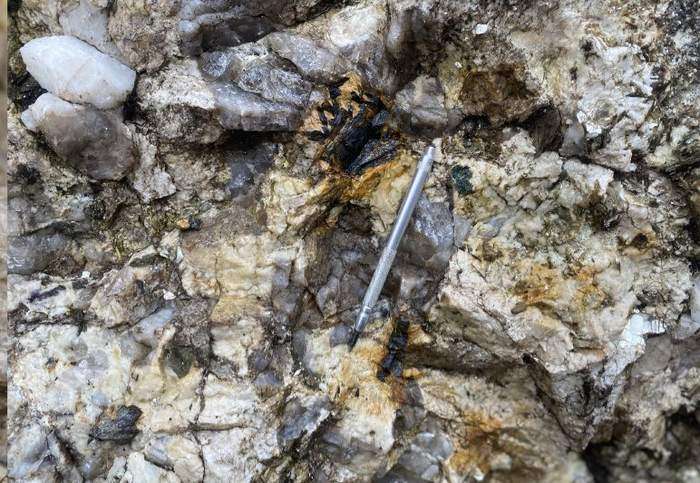
Reported niobium and related values, White Willow Property
| Parameter | Reported value | Sample type | Reported by |
|---|---|---|---|
| Niobium, Maple Leaf Dyke | 9,870 ppm Nb | Selective grab sample from surface prospecting | Grid Metals Corp, 2022 prospecting, prior operator |
| Host mineral | Columbite, of the columbite-tantalite series | Mineralogical observation | NI 43-101 technical report, White Willow Property |
| Nb/Ta ratio | Below 0.5 | Property-scale sampling discussion | NI 43-101 technical report, White Willow Property |
Attribution
The 9,870 ppm Nb figure is a selective grab sample reported by Grid Metals Corp, a prior operator, from its 2022 prospecting at the Maple Leaf Dyke. It is historical and not verified by Totec.
What the Nb/Ta ratio says
Tantalum concentrates later than niobium as a pegmatite melt evolves, so a low niobium-to-tantalum ratio points to a system that has run further down the sequence. It is a vector, not a grade. The method is set out on the White Willow project page.
The full geological picture, including the Maple Leaf showing and the sampling behind these figures, is set out on the White Willow project page. For how niobium sits alongside lithium, cesium and tantalum in the wider North American supply security picture, see Critical Metals.
See how the metals show up in the rock
Review the project geology, or the corporate materials and filings.
Investor updates
Get the next update on this ground
If the niobium story is worth watching, the fastest way to follow it is by email. You can also speak to the CEO directly.
Prefer to talk? +1 (778) 899-1780 or deepak@totecresources.com
Common Questions
Frequently asked
What is niobium used for?
Most niobium is consumed as ferroniobium, a micro-alloying addition to high strength low alloy steel. Adding a very small percentage refines the grain structure and raises strength without adding weight, which is why it is used in pipelines, structural steel, automotive bodies and bridges. Smaller volumes go into superalloys for jet engines, niobium-titanium and niobium-tin superconducting magnets used in MRI scanners and particle accelerators, and lithium niobate for optical and acoustic devices.
Where does niobium come from?
Supply is among the most concentrated of any industrial metal. The great majority comes from carbonatite-hosted pyrochlore deposits in Brazil, with Canada supplying most of the balance. Pegmatite-hosted columbite is a minor source globally.
What does the Nb/Ta ratio tell geologists?
Niobium and tantalum behave similarly but tantalum concentrates later in the fractionation sequence, so the ratio between them is used as a maturity index for a pegmatite system. A low niobium-to-tantalum ratio indicates a strongly evolved, tantalum-enriched system. It also means that in such a system niobium reads as a secondary signature rather than the primary target.
Sources
References
Every numbered claim on this page is attributed to the source it came from.
- pubs.usgs.gov Mineral Commodity Summaries 2026, Niobium (Columbium), U.S. Geological Survey
- canada.ca The Canadian Critical Minerals Strategy, Natural Resources Canada
- pubs.usgs.gov Mineral Commodity Summaries 2026, U.S. Geological Survey, March 2026
- whitehouse.gov Fact Sheet: President Donald J. Trump Announces Billions in New Deals and Investments to Power American Mining, The White House, August 7, 2026
- sedarplus.ca NI 43-101 Technical Report on the White Willow Property, Thunder Bay South Mining District, Ontario, filed on SEDAR+
Sources are named to identify where the information came from. Their inclusion does not indicate any affiliation with, sponsorship of, or endorsement of Totec Resources Ltd. by the organisations cited, or by the Government of the United States. Third-party statements describe the metal and its supply chain. They are not statements about Totec Resources Ltd. or the White Willow Property, and no inference should be drawn from them as to the presence, grade or economic viability of any mineralization on the Property.
Sources: (1) U.S. Geological Survey, Mineral Commodity Summaries, Niobium (Columbium).[1] (2) Natural Resources Canada, Canadian Critical Minerals Strategy. (3) U.S. Geological Survey, Final 2025 List of Critical Minerals.[1] Property figures are drawn from the filed technical report on the White Willow Property prepared in accordance with National Instrument 43-101, and from the 2022 surface prospecting reported by Grid Metals Corp.[5]
Market and macro information on this page describes general supply and demand for niobium and is drawn from third-party sources. It is provided for education and industry context only. It is not a forecast of prices, not a forecast of Totec Resources' results, and not investment advice.
Totec Resources has no mineral resource estimate and no mineral reserve estimate on the White Willow Property. Nothing on this page should be read as a statement that mineralization of economic value has been identified on the property.
Grab samples referred to on this page are selective by nature and are not necessarily representative of the mineralization hosted on the property. Historical results reported by Grid Metals Corp, a prior operator, have not been independently verified by Totec Resources and should not be relied upon.
The scientific and technical information on this page has been reviewed and approved by Deepak Varshney, P.Geo, CEO and Director of Totec Resources, a Qualified Person as defined by National Instrument 43-101.
This page contains forward-looking statements regarding Totec Resources Ltd. and its exploration plans. Actual results may differ materially, and readers should not place undue reliance on forward-looking information.