Cesium | Element No. 55
Cesium
Global positioning satellites, aircraft guidance and the timing layer under the world's telecom networks all run on cesium clocks. In 2025 the United States mined none of it and imported every gram. Supply traces back to a single ore mineral, in a handful of places on earth, and the two historic producers now answer to one Chinese owner.
The single largest industrial application by volume is cesium formate brine. Dissolved cesium formate makes an unusually dense, solids free fluid, and that combination is difficult to reproduce with any other chemistry. Deep, high pressure and high temperature oil and gas wells need a completion fluid heavy enough to hold back formation pressure but clean enough not to damage the reservoir or clog downhole equipment. Cesium formate does both, and because the fluid is expensive it is typically leased, recovered and recycled rather than consumed outright. Where operators use it, there is generally no straightforward substitute at the same performance.
The best known application is timekeeping. The SI second is defined by the caesium-133 atom, fixed at 9,192,631,770 cycles per second. Global positioning, secure communications and financial timestamping all inherit that definition, and they inherit it from cesium.
None of this is a bulk market. Total global consumption is measured in tens of tonnes, not millions. What makes cesium strategically interesting is not volume. It is that the applications are high value, hard to substitute, and concentrated in defence, energy and precision infrastructure.
Investor updates
Following cesium at White Willow?
News releases go out by email as the work advances. One address, no other details, and you can unsubscribe from any message.
Prefer to talk? +1 (778) 899-1780 or deepak@totecresources.com
Cesium isotopes are used as an atomic resonance frequency standard in atomic clocks, playing a vital role in aircraft guidance systems, global positioning satellites, and internet and cellular telephone transmissions.[1]

Supply
One mineral. A handful of places. One owner.
There is no cesium brine industry, no seawater extraction, no recycling stream worth the name. Commercial cesium comes from pollucite, and pollucite forms only in the most chemically evolved corner of a rare element pegmatite. Find one of those and you have found the whole supply chain.
Two mines have supplied the West
Pollucite in economic quantity is exceptionally rare. The Tanco mine at Bernic Lake, Manitoba, hosted the deposit that supplied most of the Western world's cesium for decades, and it remains the one operation the USGS records as reporting production in 2025.[1][1] Bikita, in Zimbabwe, is the other historically significant pollucite producer. The USGS has reported that the United States has no domestic production and is wholly reliant on imports and existing stocks[1], and the agency has at times been unable to publish meaningful price data because so few arm's length transactions occur.
Both now have the same owner
Control of the small producing base has consolidated. Sinomine Resource Group, a Chinese group, acquired the Tanco operation and the cesium formate specialty fluids business, and subsequently acquired Bikita. The practical result is that a single Chinese owner sits across the majority of identified global pollucite supply and the downstream fluids business built on it, while Western consumers of cesium have almost no independent alternative.
In 2025, no cesium was mined domestically, and the United States was 100% net import reliant for cesium minerals.[1]
That concentration is the reason cesium appears on critical minerals lists on both sides of the border despite its small tonnage. A supply chain with roughly two producing pollucite sources globally and one dominant owner has no redundancy. There is no cesium futures market to signal shortage, no scrap loop of consequence, and no substitute chemistry that delivers the same density in a completion fluid or the same frequency stability in a primary clock. Where a critical mineral is scarce, foreign controlled and difficult to replace, the policy interest in new Western supply is straightforward.
The United States was 100% net import reliant for its cesium needs, and the primary global producers were estimated to include Canada, China, Germany, and Russia.[1]
That interest is now written into United States policy. Executive Order 14415, signed on July 20, 2026, extends the domestic sourcing requirement past finished equipment and down into the materials the equipment is built from.
The market is small and it never slacks
About 11,000 tons of cesium formate are in circulation as drilling fluid, and roughly five percent of it is destroyed and replaced every year.[1] That is a market which has to be resupplied whether or not anyone opens a new mine. The price of the formate rose seven percent in 2025.[1]
Demand is not the constraint on cesium. Supply is.
Who actually produces it
Primary global producers of cesium, as estimated by the USGS
 Canada
 China
China Germany
 Russia
Source[1]
It is the policy of the United States that not only the finished equipment deployed by our military, but also the critical materials and components necessary to manufacture, maintain, sustain, and repair that equipment, are sourced domestically or from allied nations.[4]

The Property
What the filed work shows at White Willow
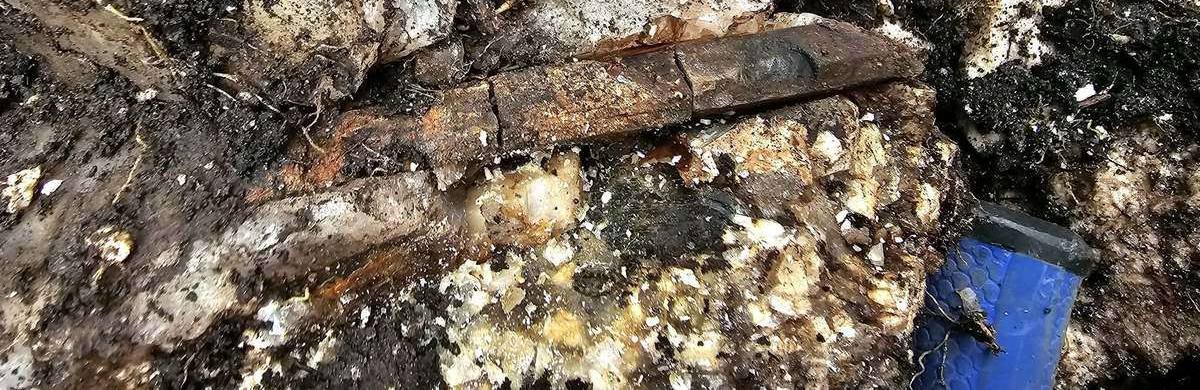
White Willow is an LCT (lithium, cesium, tantalum) pegmatite property in the Thunder Bay South Mining District of Ontario. The source of record for the figures below is the filed technical report on the property.[6] Several of the highest cesium values were reported by Grid Metals Corp, a prior operator, from its 2022 prospecting programme at the Maple Leaf Dyke, and are presented here as that company reported them rather than as results generated by Totec.
| Result | Cesium value | Attribution and sample type |
|---|---|---|
| Sample B860563, Maple Leaf Dyke | 1,730 ppm Cs | Reported by Grid Metals Corp from its 2022 prospecting programme. Selective grab sample. |
| Maple Leaf surface sampling population | 36 samples above 115 ppm Cs | Surface sampling reported in the technical report. Selective grab samples. |
| Muscovite sampling, range | 27.3 to 355 ppm Cs | Mineral chemistry sampling discussed in the technical report. 5 of 16 samples exceeded 100 ppm Cs. |
| Rare element pegmatite benchmark | Greater than 50 ppm Cs in muscovite | Published indicator threshold used to identify rare element pegmatites, not a White Willow result. |
| Spodumene bearing benchmark | Greater than 100 ppm Cs in muscovite | Published indicator threshold associated with spodumene bearing pegmatites, not a White Willow result. |
| Exocontact metasediment | 150 ppm Cs | Sampling of metasedimentary rock adjacent to the pegmatite contact, as discussed in the technical report. |
The full geological picture, including the Maple Leaf showing and the exploration work completed to date, is set out on the project page. The wider case for lithium, cesium and tantalum as North American critical minerals is set out separately.
See it in the rock
Review the property, or read how the three critical metals fit together in an LCT pegmatite system.
Investor updates
Get the next update on this ground
If the cesium story is worth watching, the fastest way to follow it is by email. You can also speak to the CEO directly.
Prefer to talk? +1 (778) 899-1780 or deepak@totecresources.com
Common Questions
Frequently asked
What is cesium used for?
The largest single use is cesium formate brine, a dense, low-solids drilling and completion fluid used in high-pressure, high-temperature oil and gas wells. Cesium is also central to atomic clocks, where the caesium-133 transition defined the SI second, and it is used in photoelectric cells, specialty optical glass and certain catalysts.
Why is cesium so rare?
Cesium has no dedicated deposit type of its own. It concentrates only at the very end of the fractionation sequence in LCT pegmatites, and it is economically recovered from essentially one ore mineral, pollucite. Very few pegmatites in the world evolved far enough to form pollucite in quantity.
What is pollucite?
Pollucite is a hydrated cesium aluminium silicate and the only ore mineral from which cesium is recovered at commercial scale. It forms in the most evolved zones of LCT pegmatites, which is why cesium mineralization is treated as an indicator that a pegmatite system is highly fractionated.
Where does the world's cesium come from?
Supply is extraordinarily concentrated. The U.S. Geological Survey reports that no cesium was mined in the United States in 2025, that the country was 100% net import reliant for cesium minerals, and that during 2025 one company in Canada reported intermittent cesium production and processing from mined ore and stockpiles at the Tanco Mine in Manitoba. Worldwide, pollucite production sits with a very small number of operations.
Is cesium a critical mineral?
Yes. Cesium appears on both Canada's Critical Minerals List and the United States critical minerals list, reflecting the combination of industrial necessity and concentrated, insecure supply.
Sources
References
Every numbered claim on this page is attributed to the source it came from.
- pubs.usgs.gov Mineral Commodity Summaries 2026, Cesium, U.S. Geological Survey
- canada.ca The Canadian Critical Minerals Strategy, Natural Resources Canada
- bipm.org The International System of Units, definition of the second, Bureau International des Poids et Mesures
- whitehouse.gov Executive Order 14415, Securing America's Defense Supply Chains and Ensuring Domestic Acquisition of Critical Materials, July 20, 2026
- sinomine.com.cn Publicly reported corporate transactions of Sinomine Resource Group, including the acquisition of the Tanco and Bikita operations
- sedarplus.ca NI 43-101 Technical Report on the White Willow Property, Thunder Bay South Mining District, Ontario, filed on SEDAR+
- geologyontario.mndm.gov.on.ca 2022 Surface Prospecting Report, White Willow Property, Grid Metals Corp, assessment file AFRI 20000022099
- totecresources.com Totec Resources Ltd., Corporate Presentation, August 2026
Sources are named to identify where the information came from. Their inclusion does not indicate any affiliation with, sponsorship of, or endorsement of Totec Resources Ltd. by the organisations cited, or by the Government of the United States. Third-party statements describe the metal and its supply chain. They are not statements about Totec Resources Ltd. or the White Willow Property, and no inference should be drawn from them as to the presence, grade or economic viability of any mineralization on the Property.
Totec Resources Ltd. has no mineral resource estimate and no mineral reserve on the White Willow Property. All exploration results described on this page are early stage exploration results only. Grab samples are selective by nature and are not necessarily representative of the mineralization hosted on the property.
Certain results described on this page were reported by Grid Metals Corp, a prior operator, from its 2022 prospecting programme at the Maple Leaf Dyke. Those results are historical in nature, they are attributed to that company, and they are not presented as results generated by Totec Resources Ltd.
Market, supply and end use information relating to cesium is drawn from third party sources, including the U.S. Geological Survey, and is provided for general industry context only.[1] It is not a forecast of prices, of demand, or of the results of Totec Resources Ltd., and nothing on this page is investment advice.
The scientific and technical information on this page has been reviewed and approved by Deepak Varshney, P.Geo, CEO and Director of Totec Resources, a Qualified Person as defined by National Instrument 43-101.
This page contains forward-looking statements regarding Totec Resources Ltd. and its exploration plans. Actual results may differ materially, and readers should not place undue reliance on forward-looking information.