The Element
United States military timing runs on it
Rubidium is element 37, a soft, silvery alkali metal sitting between potassium and cesium in the first column of the periodic table. It is so reactive that it is never found free in nature, and so soft and low melting that a sealed ampoule of the pure metal will turn liquid on a warm day.
The U.S. military frequency standard, the United States Naval Observatory (USNO) timescale, is based on a network of weighted atomic clocks, including six USNO rubidium fountain clocks.[1]

The most important application follows from the atom itself. Rubidium-87 has a hyperfine transition that can be locked onto with great precision, which is what makes a rubidium frequency standard possible. These are the compact atomic clocks that keep telecom networks, power grids and satellite ground stations in step.
Timing and navigation
Rubidium frequency standards synchronise telecom networks, broadcast infrastructure, power grids and the ground segment of satellite navigation systems, and provide holdover when satellite timing is unavailable.
Quantum and sensing
Rubidium-87 is the default atom for laser cooling. It underpins atom interferometers, cold atom gravimeters, quantum magnetometers, inertial navigation research and neutral atom quantum computing.
Optics and medicine
Photocathodes and photomultiplier tubes, nonlinear optical crystals, specialty optical glass, and rubidium-82 tracers used in cardiac positron emission tomography.
Investor updates
Following rubidium at White Willow?
News releases go out by email as the work advances. One address, no other details, and you can unsubscribe from any message.
Prefer to talk? +1 (778) 899-1780 or deepak@totecresources.com
Supply
No mine anywhere. By-product only.
Rubidium is not rare in the crust. It is roughly as abundant as zinc and more abundant than copper. What it lacks is a mineral of its own. There is no rubidium ore body anywhere in the world, and there has never been a mine operated for rubidium as its primary product.[1]
During 2025, no rubidium production was reported globally. Known production of rubidium ore from all countries ceased within the past two decades.[1]
Read that twice. Not reduced, not concentrated in one country: no production reported anywhere in the world during 2025, and the ore mining that once supplied it stopped over the past two decades. Namibia ceased in the early 2000s, Bikita in Zimbabwe was depleted of pollucite reserves in 2018, and Sinclair in Australia shipped the last of its economically recoverable pollucite in 2019.[1] What reaches the market now comes out of stockpiles.
Reports indicated that with current processing rates, the world's commercial stockpiles of rubidium ore may be depleted in the near future without additional future mineral extraction.[1]
The United States was 100% net import reliant for its rubidium needs and the primary global producers, including refined rubidium compounds, were estimated to include China, Germany, and Russia.[1]
No primary production
Because rubidium substitutes for potassium in the crystal lattice of common minerals rather than forming its own, it is dispersed. It concentrates in potassium-bearing minerals of granitic pegmatites: lepidolite, muscovite, potassium feldspar and pollucite, and in some evaporite minerals such as carnallite. All rubidium reaching the market is recovered as a by-product, mainly from the processing of lithium and cesium minerals.[1]
Concentration risk
The by-product model means rubidium availability is set by decisions made about other metals entirely. Historically, cesium and rubidium chemical supply has traced back to a very small number of pegmatite operations worldwide, and the United States Geological Survey reports no domestic mine production of rubidium, with requirements met by imports.[1] Rubidium is one of the 60 minerals on the Final 2025 List of Critical Minerals, and it is the only one of the six metals covered on this site that the list records as produced as a byproduct or co-product, naming cesium and lithium as its host commodities.[2]
That structure creates an unusual kind of fragility. A metal with large reserves in the ground can still be scarce in the market if the only plants that separate it are few, foreign and tied to another commodity cycle. Downstream separation and purification of alkali specialty chemicals is concentrated in a small number of facilities, and high purity rubidium metal and salts trade at prices per gram rather than per tonne. For Western buyers of timing hardware, quantum instruments and defence electronics, the practical question is not whether rubidium exists but whether a domestic or allied route to it exists.
This is the argument for identifying rubidium bearing pegmatite systems in North America even where rubidium would never be the reason to build a mine. Where a project is being evaluated for lithium, cesium and tantalum, rubidium enrichment in the same rock is a potential secondary credit and a jurisdictional data point. It is also, independently, one of the most useful geochemical signals an explorer has.
Market and industry information is third-party context only.
No price index, because there is barely a market
The USGS records that domestic rubidium occurrences will stay subeconomic unless market conditions change, through new end uses or higher consumption of existing ones.[1]
Quantum computing is the change everyone is watching. The USGS names it as a future application with the potential for relatively high rubidium consumption.[1]
Who actually produces it
Primary global producers of rubidium, including refined compounds
 China
China Germany
 Russia
Source[1]
Canada was a major supplier of 16 of these mineral commodities, including 4 for which Canada was the leading supplier.[3]
The Property
What the filed work shows at White Willow
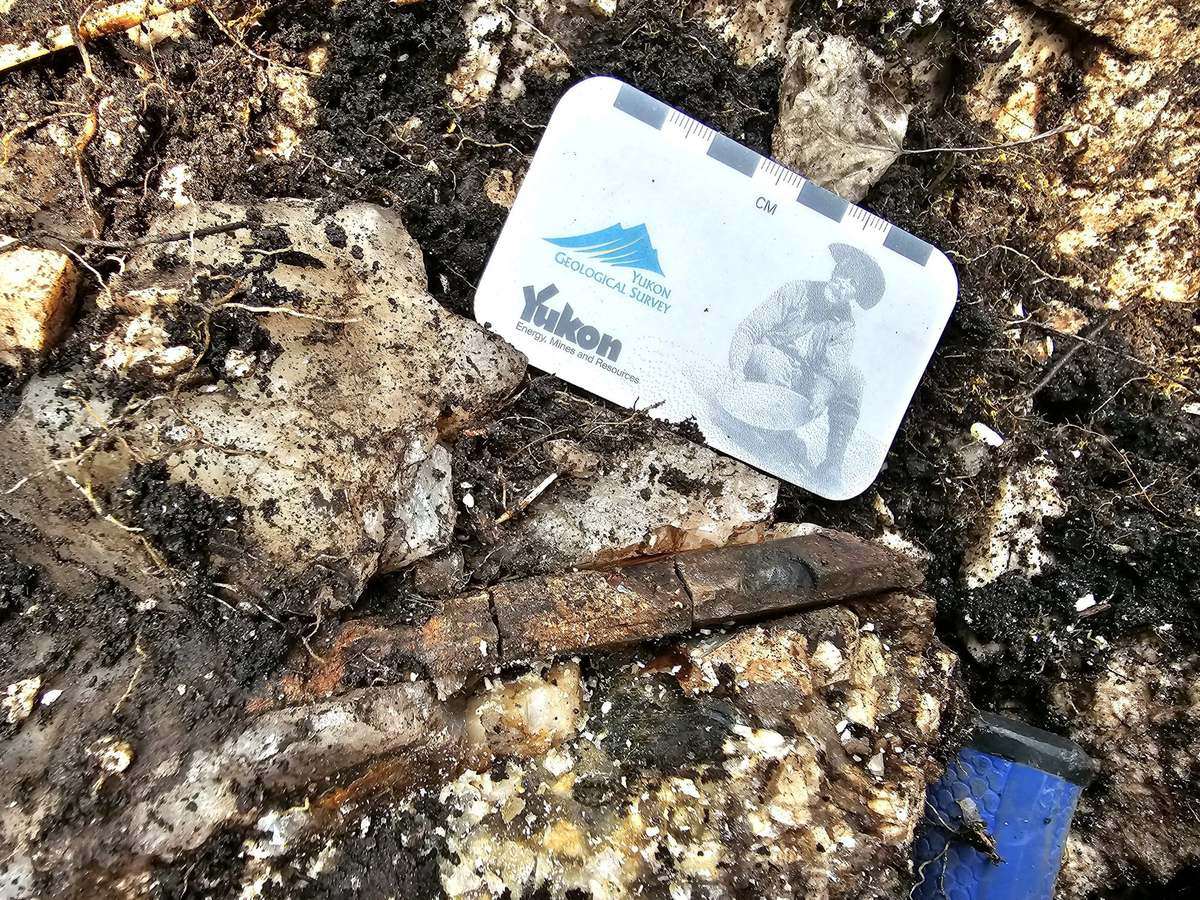
Context matters here, and the technical report supplies it. Muscovite from the most strongly fractionated rare-element pegmatites globally typically carries in excess of 10,000 ppm Rb. White Willow muscovite sits below that benchmark. The correct reading is that the property is demonstrably evolved and rare-element fertile, but that rubidium at White Willow is an indicator and a possible secondary credit, not a headline grade and not a stand-alone target.
| Measure | Result | Sample basis and source |
|---|---|---|
| Muscovite Rb range | 553 to 2,540 ppm Rb | Mineral separates discussed in the filed technical report on the White Willow Property[1] |
| Muscovite samples above 1,000 ppm Rb | 14 of 16 samples | Same sampling population as above[1] |
| Largest exocontact metasediment assay | 607 ppm Rb | Selective grab sample of exocontact metasediment[1] |
| K/Rb ratio in muscovite | Below 20 | Fractionation index calculated from the muscovite population, indicating a highly evolved system[1] |
| Global benchmark for comparison | Typically >10,000 ppm Rb | Muscovite from strongly fractionated rare-element pegmatites generally, as cited in the technical report. White Willow sits below this benchmark[1] |
Figures are from the technical report's muscovite and exocontact sampling, historical and not verified by Totec. Grab samples are selective by nature.
Rubidium is one line in a larger geochemical picture at White Willow. The same fractionation that concentrates rubidium in mica is what concentrates lithium, cesium and tantalum, the three metals the project is actually being evaluated for. To see the property geology, the pegmatite field and the full sampling record, visit the White Willow Project page. For the demand and supply security case behind the metals themselves, see Critical Metals.
Investor updates
Get the next update on this ground
If the rubidium story is worth watching, the fastest way to follow it is by email. You can also speak to the CEO directly.
Prefer to talk? +1 (778) 899-1780 or deepak@totecresources.com
Common Questions
Frequently asked
What is rubidium used for?
Rubidium's main uses are in precision timing and sensing. Rubidium atomic clocks are smaller and cheaper than cesium standards and are used in telecommunications networks, satellite navigation and laboratory instruments. It also appears in specialty optical glass, photocells, vacuum tube getters and in cold-atom research underpinning quantum sensing.
Why is there no rubidium mine?
Rubidium does not form ore minerals of its own in economic quantity. It substitutes for potassium in micas and feldspars, so it is dispersed rather than concentrated. All production is therefore a by-product, principally of lithium and cesium processing, which makes supply a function of somebody else's production decisions rather than of rubidium demand.
What does the K/Rb ratio tell geologists?
Rubidium substitutes for potassium but concentrates progressively as a melt evolves, so the potassium-to-rubidium ratio falls as fractionation advances. A low K/Rb ratio is one of the standard indicators that a pegmatite is highly evolved, which is why rubidium is valued in exploration as a vector rather than as a product.
Sources
References
Every numbered claim on this page is attributed to the source it came from.
- pubs.usgs.gov Mineral Commodity Summaries 2026, Rubidium, U.S. Geological Survey
- federalregister.gov Final 2025 List of Critical Minerals, U.S. Geological Survey, 90 FR 50494, November 7, 2025
- pubs.usgs.gov Mineral Commodity Summaries 2026, U.S. Geological Survey, March 2026
- sedarplus.ca NI 43-101 Technical Report on the White Willow Property, Thunder Bay South Mining District, Ontario, filed on SEDAR+
Sources are named to identify where the information came from. Their inclusion does not indicate any affiliation with, sponsorship of, or endorsement of Totec Resources Ltd. by the organisations cited, or by the Government of the United States. Third-party statements describe the metal and its supply chain. They are not statements about Totec Resources Ltd. or the White Willow Property, and no inference should be drawn from them as to the presence, grade or economic viability of any mineralization on the Property.
Sources: (1) U.S. Geological Survey, Mineral Commodity Summaries, Rubidium and Cesium.[1] (2) U.S. Geological Survey, Final 2025 List of Critical Minerals.[1] (3) Filed NI 43-101 technical report on the White Willow Property, and historical prospecting results referenced therein.[4]
No mineral resource estimate. Totec Resources has no mineral resource estimate and no mineral reserve estimate on the White Willow Property. Nothing on this page should be read as a statement of resources, reserves or economic viability. The property is at an early exploration stage and there is no assurance that a commercially viable deposit exists on it.
The scientific and technical information on this page has been reviewed and approved by Deepak Varshney, P.Geo, CEO and Director of Totec Resources, a Qualified Person as defined by National Instrument 43-101.
Historical exploration results referenced on this page, including results generated by prior operators of the property such as Grid Metals Corp, are drawn from the filed technical report and from public assessment filings.[4] Totec has not independently verified these historical results, and they should not be relied upon.
General information on rubidium chemistry, applications and global supply is drawn from third-party public sources and is provided for educational and market context only. It is not a forecast of prices, of demand, or of Totec Resources' results, and it is not a statement that any Totec mineral is used in any of the applications described.
This page contains forward-looking statements regarding Totec Resources Ltd. and its exploration plans. Actual results may differ materially, and readers should not place undue reliance on forward-looking information.